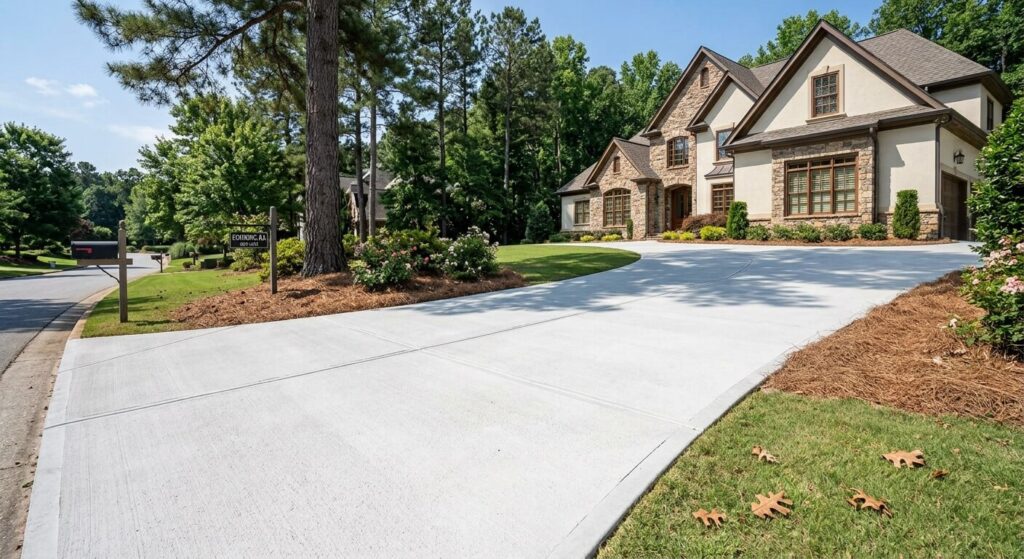
Your driveway is one of the first features people notice when approaching your home, but it also has an important practical job. It needs to withstand vehicles, weather, water, and everyday wear without becoming a maintenance headache. For homeowners considering concrete driveway installation, Able Concrete of GA can help create a driveway designed around the property’s needs.
A successful driveway project involves more than pouring concrete. Proper planning, site preparation, drainage, reinforcement, finishing, and curing can all affect the finished surface and its long-term performance.
Why Choose Concrete for a Driveway?
Concrete remains a popular driveway material because of its combination of strength, versatility, and appearance. A properly designed and installed concrete driveway can provide a long-lasting surface for residential vehicles while requiring relatively little routine maintenance.
The Portland Cement Association notes that concrete pavements can provide long service lives when they are properly designed, constructed, and maintained.
Concrete can also be customized. Homeowners can choose traditional gray concrete or consider decorative finishes, borders, textures, and other design details that complement the home’s exterior.
How Important Is Site Preparation?
One of the most important parts of driveway installation happens before the concrete is poured.
The existing surface may need to be removed, and the underlying area should be properly graded and compacted. A stable base helps provide consistent support beneath the driveway and can reduce the risk of settlement and cracking caused by inadequate preparation.
The American Concrete Institute emphasizes the importance of proper preparation, placement, finishing, and curing when constructing concrete slabs.
For properties with drainage concerns, grading should also direct water away from structures and prevent standing water from repeatedly affecting the driveway.
How Thick Should a Concrete Driveway Be?
Driveway thickness should be determined according to expected loads, soil conditions, base preparation, and local construction considerations rather than using one measurement for every property.
A commonly used residential guideline is approximately 4 inches for passenger-vehicle driveways, while heavier vehicles or specific site conditions may require additional thickness or reinforcement.
Homeowners should discuss expected vehicle loads with their concrete contractor before installation. A driveway regularly used by work trucks, trailers, recreational vehicles, or other heavy equipment may need a different design from one used primarily by family cars.
What About Expansion and Control Joints?
Concrete naturally changes dimension as temperatures and moisture conditions change. Control joints are therefore an important part of driveway construction.
Properly placed joints help guide where cracking is more likely to occur instead of allowing random cracking across the slab. The spacing and depth of joints should be appropriate for the driveway’s dimensions and construction.
This is another reason professional installation matters. A driveway isn’t simply a flat slab of concrete; its design needs to account for movement, drainage, loads, and environmental conditions.
How Long Does New Concrete Take to Cure?
Fresh concrete needs time to develop strength. Homeowners should follow their contractor’s instructions regarding when vehicles and heavy loads can return to the driveway.
Concrete does not simply “dry.” It gains strength through hydration, a chemical process involving cement and water. The American Concrete Institute commonly uses 28 days as a reference age for concrete strength testing, although the concrete continues to gain strength beyond that point.
Weather conditions can also influence construction and curing. Extreme heat, cold, or changing moisture conditions may require adjustments to installation practices.
How Can You Keep a Concrete Driveway Looking Good?
Routine maintenance can help extend the useful life and appearance of a concrete driveway. Keep the surface reasonably clean, address drainage issues, and avoid allowing problems to remain unresolved.
Sealing may also be appropriate depending on the concrete finish and exposure conditions. Homeowners should ask their contractor which maintenance and sealing schedule is suitable for the specific driveway.
Cracks or surface problems should also be evaluated rather than automatically ignored. Early attention can sometimes prevent minor issues from becoming larger repairs.
Ready to Plan Your Driveway Project?
If you’re considering concrete driveway installation in Cumming, GA, as well as surrounding North Georgia communities, Able Concrete of GA can help you plan a driveway based on your property’s layout, expected use, and desired appearance. Call (404) 694-8473 to discuss your project and explore options for a durable, attractive concrete driveway built to handle everyday use.