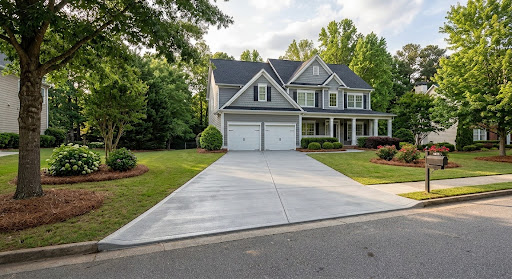
A driveway does more than give vehicles a place to park. It is one of the first features people notice when approaching a home and one of the most frequently used exterior surfaces. For homeowners considering driveway installation, understanding site preparation, drainage, material selection, and maintenance can help create a surface that looks good and performs reliably. Able Concrete of GA provides concrete services for residential and property improvement projects throughout Georgia.
Why Is Proper Driveway Preparation So Important?
A durable driveway starts below the finished surface. Even high-quality concrete can develop problems if the underlying soil is unstable or improperly prepared.
Before installation, the site may need excavation, grading, compaction, and preparation of an appropriate base. The exact requirements depend on existing soil conditions, drainage, slope, intended use, and the condition of the property.
Poor preparation can contribute to settlement, cracking, standing water, or uneven surfaces over time. Investing attention in preparation can therefore be just as important as selecting the visible finish.
Should You Choose Concrete for Your Driveway?
Concrete is a popular driveway material because it can provide a durable, relatively low-maintenance surface when properly designed and installed.
The Portland Cement Association notes that concrete pavement can have a long service life when appropriate design, construction, and maintenance practices are followed.
Concrete also provides design flexibility. Homeowners can choose a traditional smooth finish or explore decorative options such as stamped patterns, borders, exposed aggregate, or different textures.
The right choice depends on the home’s architecture, budget, maintenance expectations, and desired appearance.
How Does Drainage Affect a Driveway?
Water is one of the biggest considerations in any exterior concrete project. A driveway should be designed so that rainwater does not collect against the home, garage, foundation, or other structures.
Proper grading can help direct water toward appropriate drainage areas. Depending on the property, additional drainage solutions may be necessary.
This is especially important in Georgia, where heavy rainfall can place significant demands on residential drainage systems. A driveway that looks excellent immediately after installation can still experience problems if water continually collects beneath or around it.
How Thick Should a Residential Concrete Driveway Be?
There isn’t one thickness that works for every property.
Residential driveways are commonly designed around anticipated vehicle loads, soil conditions, reinforcement requirements, and local construction considerations. Standard passenger vehicles create different demands than heavy trucks, recreational vehicles, or commercial traffic.
Instead of choosing thickness based solely on a generic number, homeowners should have the project evaluated according to its actual use. Proper reinforcement and base preparation can also influence performance.
Can a New Driveway Improve Curb Appeal?
Absolutely. A driveway occupies a significant amount of visible space, making its design an important part of a home’s exterior appearance.
A straightforward concrete finish can provide a clean, classic appearance. Decorative borders or stamped patterns can create more visual character, particularly when coordinated with walkways, patios, retaining walls, or other hardscape features.
Color and texture can also help connect the driveway with the home’s exterior materials. The goal isn’t necessarily to make the driveway stand out—it should complement the property as a whole.
When Should You Replace an Existing Driveway?
Replacement may be worth considering when a driveway has extensive cracking, major settlement, drainage problems, or surface deterioration.
Small cosmetic cracks don’t automatically mean an entire driveway needs replacement. However, widespread structural problems can become increasingly difficult to address with isolated repairs.
Homeowners should also consider whether the existing driveway has drainage or grading problems. Installing a new surface without correcting the underlying issue could simply reproduce the same problem.
What Maintenance Does a Concrete Driveway Need?
Concrete driveways generally require less routine maintenance than many other exterior surfaces, but they are not maintenance-free.
Regularly removing dirt and debris can keep the surface looking better. Spills should be addressed promptly, and homeowners should monitor cracks or areas where water begins to collect.
The American Concrete Institute emphasizes that appropriate construction practices and maintenance contribute to the performance and durability of concrete structures.
Keeping drainage systems clear is also important because water should be directed away from the driveway and foundation rather than allowed to accumulate.
Ready for a New Driveway?
A driveway is a long-term investment in your property’s appearance, accessibility, and functionality. From grading and base preparation to concrete selection, drainage, reinforcement, and finishing, each stage can affect the final result. If you’re planning driveway installation in Norcross, GA, Able Concrete of GA can help you plan a concrete project around your property’s needs. Call us at (404) 694-8473 to discuss your driveway project and explore professional concrete installation options for your home.